
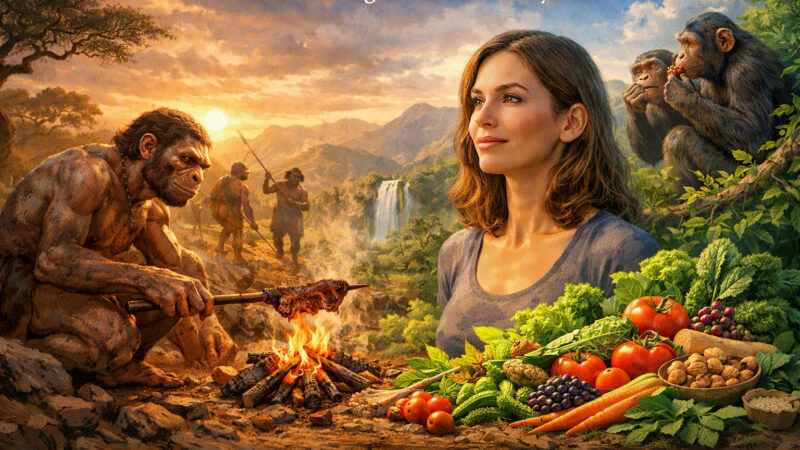
Humans have long been described as omnivores, a dietary label based on our capacity to eat both plants and animal flesh. Yet many argue that this description is not part of our formal taxonomy. Within zoology, “omnivore” is not a rank but a functional category used to describe feeding behavior. It reflects what humans can eat, not necessarily what our physical characteristics, biology, and instincts reveal about us. In popular debates, some advocates of plant‑based eating counter this by calling humans herbivores, pointing to our ability to thrive on plants alone. Critics rightly respond that we are not like cows or horses, and they are correct. True herbivores such as ruminants have specialized digestive systems that humans simply do not possess.
The discussion remains unsettled. If neither “omnivore” nor “herbivore” fully captures our nature, then what could our design truly point toward? Let’s discover the evolutionary path that shaped our species and the consequences of classifying humans as omnivores.
True Omnivores vs. Humans
True omnivores, such as bears, pigs, or raccoons, instinctively consume whatever is available in their environment. They forage berries, dig up roots, eat insects, and even consume carrion or live prey — all without hesitation, tools, or preparation. Their bodies are equipped with sharp teeth, claws, and digestive systems that can neutralize pathogens and break down raw flesh quickly. For them, omnivory is a matter of instinct and biology.
Humans, by contrast, do not share this opportunism. We lack claws to tear flesh, sharp fangs to puncture hides, or stomach acid strong enough to safely neutralize raw meat bacteria. Instead, we rely on external aids: fire to cook, knives to cut, pots to boil, and cultural conditioning to normalize what would otherwise be repulsive.
This reliance on technology shows that our so‑called omnivory is technological, not instinctive. It is an adaptation born of survival pressures and cultural invention, not a natural drive. Without tools and fire, our diet would collapse back to what our anatomy and instincts support: fruits, soft plant matter, and starches.
True Herbivores vs. Humans
Critics rightly respond that we are not like cows or horses, and they are correct. True herbivores such as ruminants have specialized digestive systems that humans simply do not possess. Cows, for example, have a four‑chambered stomach designed to ferment cellulose, while horses have an enlarged cecum for fermenting fibrous plants.
Humans lack these adaptations. Our stomach is single‑chambered and relatively simple, and our intestines are not specialized for fermenting grass or raw leaves in bulk. We cannot subsist on raw pasture the way cows or horses do. Instead, our digestive system is optimized for softer plant foods — fruits, tubers, and starches — which require less complex fermentation.
This distinction is crucial: it shows that while humans thrive on plants, we are not herbivores in the strict anatomical sense. What we share with herbivores is the ability to live healthily on plant foods — but what could our design truly point toward?
Scientific Classification and Anatomy of Humans
Scientifically, humans are classified as Animalia, Chordata, Mammalia, Primates, Hominidae, Homo sapiens. This formal taxonomy is fixed and universally recognized. It defines our place in the animal kingdom but does not prescribe our diet. The classification of omnivore is a descriptive label of feeding behavior, not a scientific rank. To understand where humans truly belong, we must look at anatomy, biology, instinct — and genetics.
Humans share about 98.7 to 99 percent of DNA with chimpanzees and bonobos, making them our closest living relatives. Chimpanzees eat a diet that is 50 to 70 percent fruit, supplemented with leaves, seeds, insects, and occasional small prey. Bonobos are even more fruit‑dominant, with less meat than chimps, and both species instinctively prefer ripe fruit, guided by color vision and sweetness — the same sensory adaptations humans share.
Our teeth, digestive system, and sensory adaptations all point to fruit and starch as our natural food sources. Our hands are designed to grasp and peel fruit, our trichromatic vision evolved to detect ripeness, and our taste buds are tuned to sweetness rather than flesh. Fossil evidence shows that early hominins lived primarily on fruits, tubers, and leaves, with meat introduced only later through tools and cooking.
Humans carry multiple copies of the AMY1 gene, which produces salivary amylase — the enzyme that begins starch digestion in the mouth. Populations historically dependent on starchy foods, such as rice in Asia or wheat in the Middle East and Europe, often show even higher AMY1 copy numbers. This variation reflects evolutionary pressure toward starch consumption, a trait absent in carnivores and rare in true omnivores.
We do not crave blood nor chase an animal to kill it. On the contrary, our bodies are built to escape predators, to sweat and cool down, and to endure. Our hands and fingers are made to pick and peel fruits. Our teeth are small and not sharp. Our digestion of raw meat is hard and slow, exposing us to dangerous bacteria and parasites. Our eyes are tuned to see the colors of fruits, and our tongue is designed to taste sweetness. These instincts, combined with our genetic adaptation to starch, raise the question: what could our design truly point toward? To answer this, we must trace the evolutionary timeline that shaped our species.
Evolutionary Timeline
For millions of years, our ancestors lived primarily as frugivores. The incorporation of meat into the human diet only became notable with the advent of tools and fire around two million years ago, and agriculture with animal farming only appeared about ten thousand years ago — a blink of an eye compared to the vast history of frugivorous evolution. This short period of meat consumption has not fundamentally altered our anatomy.
At the same time, human evolution shows a clear adaptation toward starch consumption. Beyond fruit, humans show a deep evolutionary adaptation to starches and grains. Isotope studies of early hominins reveal that by 3.8 million years ago, Australopithecus species were already consuming grasses and sedges, while later Homo species relied heavily on tubers and underground starch organs.
Remarkably, this dietary shift occurred hundreds of thousands of years before our teeth evolved to process such foods efficiently — a case of behavior driving anatomy. This adaptation is absent in carnivores and rare in true omnivores, underscoring that humans are biologically aligned with starch‑rich plant diets rather than raw flesh.
Grainivore Adaptations
Genetic evidence reinforces grainivore adaptation. Humans carry multiple copies of the AMY1 gene, which produces salivary amylase, the enzyme that begins starch digestion in the mouth. Populations historically dependent on rice, wheat, or maize often show even higher AMY1 copy numbers, reflecting evolutionary pressure toward starch consumption. Anthropologists sometimes describe this specialization as grainivory — an evolutionary niche where humans thrive on grains, legumes, and tubers. Civilizations across history, from Mesopotamia to Asia and the Americas, were built on these foods, underscoring that our biology and culture converged around starch.
Lactase Persistence: A Cultural Mutation
With over 75 percent of humans on the planet unable to properly process lactose, it is evidence enough that milk consumption is not in accordance with our natural biology. The reduction of lactase activity after infancy is a genetically programmed event. Lactase is necessary for the digestion of lactose, the main carbohydrate in milk, and without it, milk consumption can lead to bloating, flatulence, cramps, and nausea.
Those who cannot digest milk were once labeled “lactose intolerant.” Today, they are regarded as normal, while the minority of adults who retain the enzymes allowing them to digest milk are called “lactase persistent.” This persistence only appeared since the domestication period, roughly 7,000–10,000 years ago, when humans began keeping livestock for milk. Genetic mutations in certain populations allowed lactase production to continue into adulthood — an adaptation driven by culture, not biology.
Milk itself is biologically engineered for calves: rich in hormones, proteins, and growth factors designed to rapidly build the body of a young cow. It was never intended for human infants, let alone adults. No species in nature drinks the milk of another, nor do adults continue to consume milk meant for infants. To drink cow’s milk is to hijack nourishment intended for calves, forcing our bodies to process what was never designed for us.
Nature’s design is clear: milk belongs exclusively to infants of their own species, never to adults, and never across species boundaries.
Modern Nutrition Evidence
Modern studies confirm that humans have a unique ability to digest starches from grains, legumes, and vegetables. This adaptation is visible in our genetics: humans carry multiple copies of the AMY1 gene, which produces salivary amylase — the enzyme that begins starch digestion in the mouth. Populations historically dependent on starchy foods, such as rice or wheat, often show even higher AMY1 copy numbers, reflecting evolutionary pressure toward starch consumption.
Our digestive tract also supports this specialization. With moderately long intestines and a relatively simple stomach, humans are optimized for breaking down complex carbohydrates and fibers. Unlike carnivores, who rely on short, acidic digestive systems to process raw flesh quickly, humans excel at extracting energy from starches and plant matter. This explains why grains, legumes, and tubers have fueled civilizations for millennia.
Nutrition organizations worldwide — including the Academy of Nutrition and Dietetics, the British Dietetic Association, and the World Health Organization — affirm that a purely plant‑based diet is suitable and sufficient to provide all essential nutrients for the human body at every stage of life: infancy, childhood, adulthood, pregnancy, and old age.
Consequences of Misclassification
Misclassifying humans as omnivores has consequences far beyond taxonomy. It legitimizes industries that exploit animals, normalize suffering, and devastate ecosystems. By accepting “omnivore” as our identity, society justifies factory farming, mass slaughter, and the commodification of sentient beings.
This misclassification fuels misinformation in nutrition, convincing people that animal products are “necessary” despite overwhelming evidence that plant‑based diets can sustain health at every stage of life. It perpetuates traditions that harm both animals and humans, while accelerating climate change through deforestation, methane emissions, and water depletion.
The cost is immense: billions of animals bred into existence, confined and killed each year, ecosystems stripped of balance, and human health burdened by preventable diseases linked to diets heavy in animal products. Misclassification is not a neutral error — it is a narrative that sustains exploitation, disease, and ecological collapse.
Conclusion: Beyond Biology, Toward Morality
Humans are not omnivores by instinct, nor herbivores by anatomy. We are primates misclassified by a false debate. The question remains: if neither omnivore nor herbivore truly defines us, what could our design truly point toward? Recognizing this possibility reshapes how we understand nutrition, anthropology, and ethics — and invites us to reconsider what humans were designed to be.
Debates about human evolution never truly end. Some argue that our species advanced because we consumed meat, others insist it was starch, while still more point to fire, tools, or social cooperation. Each perspective highlights a different factor, and the arguments circle endlessly around biology and survival. Yet focusing only on what fueled our physical development misses the larger truth: the most decisive form of evolution is not about the mechanics of digestion, but about the direction of our conscience.
Ultimately, the only evolution that truly matters is our moral evolution. Today, we have the power to choose. We can choose domination, exploitation, cruelty, and bloodshed — or we can choose compassion, justice, and veganism. Our choices are not just about survival; they are reflections of our character and our values. In the end, what defines us is not what we can eat, but what we decide to stand for.
References
- Cerling, T. E., et al. (2011). Diet of early hominins. Proceedings of the National Academy of Sciences, 108(23), 9333–9337. https://doi.org/10.1073/pnas.1104627108
- Perry, G. H., et al. (2007). Diet and the evolution of human amylase gene copy number variation. Nature Genetics, 39(10), 1256–1260. https://doi.org/10.1038/ng2123
- Academy of Nutrition and Dietetics. (2016). Position of the Academy of Nutrition and Dietetics: Vegetarian Diets. Journal of the Academy of Nutrition and Dietetics, 116(12), 1970–1980. https://doi.org/10.1016/j.jand.2016.09.025
- British Dietetic Association. (2017). Plant-based diets position paper. BDA Publications. https://www.vegansociety.com/whats-new/news/british-dietetic-association-confirms-vegan-diets-support-healthy-living
- Recent Review (MDPI Nutrients, 2023) A comprehensive review concluded that plant‑based diets, including starch‑rich foods, are adequate for all life stages when properly planned. It highlights evolutionary reliance on carbohydrate‑rich plants. MDPI Nutrients 2023
- Isotope Evidence (PNAS, 2011) Cerling et al. found that Australopithecus afarensis (~3.8 million years ago) consumed graminoids (grasses and sedges), and Homo rudolfensis (~2.3 million years ago) relied on carbohydrate‑rich tubers and bulbs. This shows early humans ate starches long before their teeth adapted. PNAS study https://doi.org/10.1073/pnas.1104627108
- Hohmann, G., & Fruth, B. (2003). Dietary preferences of bonobos and chimpanzees. International Journal of Primatology, 24(3), 563–586.
https://doi.org/10.1023/A:1023707706817https://www.researchgate.net/publication/389678306_Chimpanzee_and_bonobo - Stanford, C. B. (1996). The hunting ecology of wild chimpanzees. American Scientist, 84(5), 420–427. https://www.researchgate.net/publication/227979660_The_Hunting_Ecology_of_Wild_Chimpanzees_Implications_for_the_Evolutionary_Ecology_of_Pliocene_Hominids
- Life University. (2021). Lactose Intolerance – Slice of Life. https://living.life.edu/slice-of-life/lactose-intolerance/
Recommended Reads: Dismantling the Hierarchy of Bias: Affirming Equal Moral Worth for All Beings
